So that’s a very simple question with a very complicated answer.
The relationship between
wheel travel and
shock stroke is called
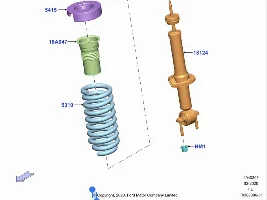
Motion Ratio. If you watch the Shock Surplus YouTube channel, Bowen often talks about this. The ‘problem’ per se is Motion Ratio is not a 1:1 ratio. If we knew the exact lengths of the control arms, knuckle offsets, hub offset, etc. etc. etc. we could calculate it, but for our purposes the easiest way is to physically measure it.
We can however make some estimations. ChatGPT says the average motion ratio for a Short-Long Arm (SLA) suspension is 0.7:1 to 0.9:1, so we can assume 0.8:1. This means for every 0.8” of shock stroke, the wheel will move 1”.
This Motortrend article claims a regular F150 has 9” of wheel travel and the Tremor has +1” of front suspension travel (and +1.5” rear).
https://www.motortrend.com/features/2021-ford-f-150-raptor-versus-2021-ford-f-150-tremor
I’ve always been lead to believe the regular F150 has 8” of front suspension travel but I cannot find any source which confirms this. Therefore, assuming the Motortrend article is accurate, the regular F150 has 9” of travel with a 5” stroke shock and the Tremor has 10” of travel with a 5.5” stroke shock.
The problem as you can probably see is that would mean the F150 has a motion ratio of 0.5:1 which is quite far outside what ChatGPT estimates for a SLA suspension. Additionally, 10” of front suspension seems suspiciously long considering the Gen 2 Raptor has a shock stroke of 7.85” and has 13” front suspension travel.
I personally suspect the Motortrend article is mixing-up increased ride-height over an F150 (which is +1” in the front and +1.5” in the rear) and suspension travel (which I suspect the Tremor is 9”). That would put a regular F150 @ 8.2” travel (assuming a 0.8:1 motion ratio). Likewise, we can also estimate a Tremor with a longer 6”-stroke shock will have
9.8” front suspension travel.
Something that confirms as well as contradicts this is
@PNWTremor has the Bilstein 6112 which has 5.97” stroke and he is citing 9” of front wheel travel. That said, I don’t know how he measured this (was the spring and bump-stop removed)? If the bump-stop was on the shock, this would likely account for 0.8” or more measured wheel travel. Then again, the bump stop will never compress to 0%, so there will be a small difference between theoretical and applied wheel travel based on shock length alone.



 .
.