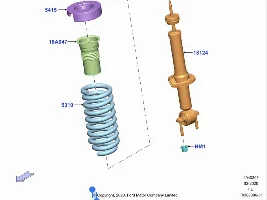
@FwtxTremor the new spring rate is 11.6kg/mm (650lb/in) the former rate was 12.5kg/mm (700ib/in) what is still a bit of guesswork is how much preload equates to how much lift.
the lift comes from a combination of the strut length + preload. the strut length is fixed and the preload is adjustable. the struts are ~0.75" longer than OE Tremor which equates to ~1.05" of lift assuming the same sag (sag = the amount of downward travel, and sag is set based on the amount of preload). any additional lift beyond this ~1.05" comes as a result of reducing the amount of downward travel.
@halo.f150 it would be great to build a data base of how much preload equates to how much lift

the only way to do this accurately is to measure Fender-to-Ground before lift, and again after lift (after driving) with the same tires, PSI, amount of fuel, and load in the bed/cab. The measurement needs to be done on the same shop floor location, the point of measurement on the fender must be marked (for consistency), and the measurement needs to be done along a level or a plumb bob striking through the wheel center up to the fender.
The springs are 406mm (15.98") long. The amount of preload can only be measured by measuring the spring length (preloaded) and subtracting that from 406mm. It would be great to verify the unloaded 'free' length of these springs to see if the starting point is really 406mm as well.
@halo.f150 another way to do it, more rough, is how much does one additional full-turn of the preload collar lift the truck? this is tricky because you need to adjust the preload collar when its un-loaded, and the act of unloading, adjusting, then re-loading the suspension will not produce a repeatable measurement due to stiction. in my experience you need to drive the truck (just briefly up/down the street with a few nose dives) to activate the suspension in order to overcome this stiction and take a good measurement.